
 EN
EN
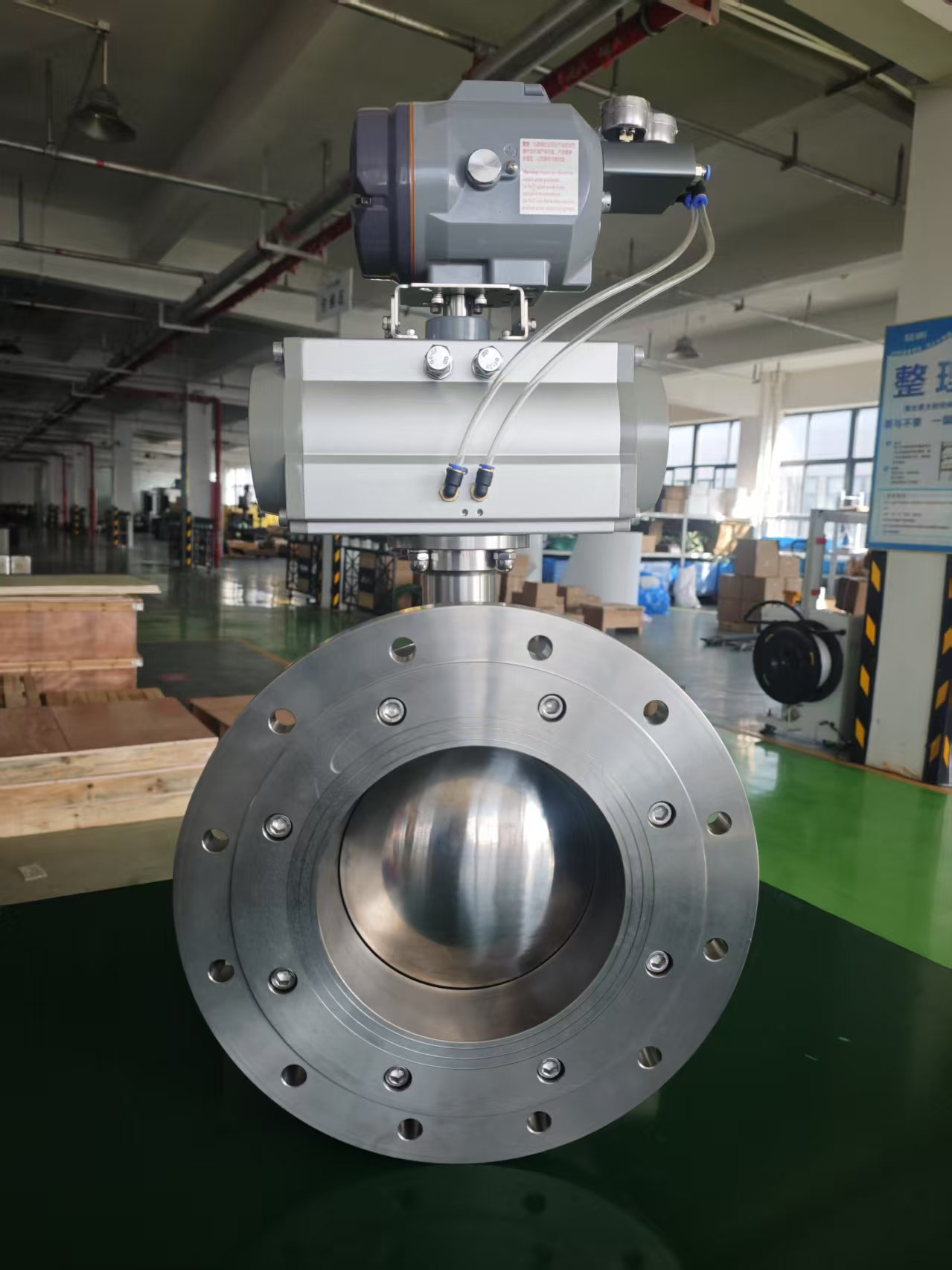
Core Design Architecture: Segmented Ball vs Solid Ball
V-Notch Geometry and Rotational Flow Path Optimization in Ball Segment Valve Designs
The ball segment valve redefines flow control through its precisely engineered V-notch geometry. Unlike full-port spherical obstructions, the segment’s contoured edge creates laminar, rotational flow paths—reducing turbulence by up to 40% (per fluid dynamics modeling validated against ISO 5167 test protocols). This design ensures stable flow coefficient (Cv) performance across partial openings while minimizing shear forces on sensitive or shear-thinning media. Its partial-arc rotation enables smooth, surge-free modulation—critical for batching, dosing, and pressure-sensitive processes. Material and actuation efficiency are also enhanced: the lower-mass segment requires ~30% less actuator torque than solid-ball equivalents while sustaining identical ASME B16.34 pressure ratings.
Inflatable Seal Mechanism vs Fixed Soft/Hard Seat Sealing in Traditional Ball Valves
Traditional ball valves use static soft (e.g., PTFE, EPDM) or metal-seated designs that rely on constant mechanical compression—leading to progressive wear and seal degradation after ~50,000 cycles (per API RP 590 field data). In contrast, modern ball segment valves integrate a pneumatic inflatable seal that engages only at closure. This dynamic strategy reduces operational seat friction by 90% (per ASTM D1894 tribology benchmarks), eliminating drag during throttling. When pressurized, the elastomeric bladder applies uniform radial force against the segment surface, achieving ANSI Class VI leak-tightness (<0.0005% bubble rate) without permanent deformation. Fully retracted during flow, it introduces no flow-path obstruction—cutting pressure drop (ΔP) by 15–25% versus fixed-seat counterparts.
Flow Control Performance: Throttling Precision and Cv Consistency
The ball segment valve delivers industry-leading throttling precision and Cv consistency—directly addressing the nonlinear, unstable flow behavior endemic to standard ball valves. Its architecture supports reliable, linear modulation across variable loads, supporting energy-efficient, low-maintenance operations.
Modulating Capability of the Ball Segment Valve Across Partial Openings
Optimized V-notch geometry enables precise, incremental flow adjustment between 10% and 70% opening—without flow jumping, hysteresis, or lag. Standard ball valves suffer from abrupt flow transitions and dead bands below 40% open due to fixed-seat geometry and turbulent wake formation, causing overshoot and instability in closed-loop systems. In applications like chemical dosing, HVAC hydronic balancing, or batch reactor feed control, this precision reduces energy waste by up to 20%, maintains tighter process variables, and extends service life of pumps and instrumentation downstream.
Cv Curve Linearity Comparison: Ball Segment Valve vs Standard Ball Valve
Ball segment valves maintain near-linear Cv response across their full operating range—a key enabler of high-fidelity process control. Standard ball valves exhibit highly non-linear Cv curves, particularly below 30% opening, where flow becomes unpredictable and turndown ratios collapse (often to ≤3:1 when oversized). In contrast, ball segment valves sustain turndown ratios of 50:1 or higher under load, enabling consistent, repeatable control in high-variability environments such as water treatment, power plant condensate systems, and pharmaceutical fluid handling. This linearity cuts calibration frequency by >15% and improves overall system stability without requiring compensatory control logic.
Sealing Integrity, Pressure Loss, and Long-Term Reliability
ANSI Class VI Leak Rates vs Inflatable Seal Performance Under Cycling Stress
Inflatable seals in ball segment valves deliver leak rates consistently below 0.0005%—exceeding ANSI Class VI requirements by up to 80% in high-pressure steam (up to 600 psi) and thermal cycling scenarios. Unlike rigid PTFE seats prone to extrusion, cold flow, and thermal creep, the reinforced elastomeric bladder retains dimensional integrity across repeated expansion/contraction cycles. Field data from pulp & paper and petrochemical installations confirm stable sealing performance beyond 10,000 cycles—even with particulate-laden or thermally aggressive media.
Pressure Drop Analysis (ΔP) from 10% to 100% Flow: Implications for System Efficiency
Ball segment valves maintain a near-linear ΔP profile, deviating <15% from ideal Cv behavior across all openings. At 30% open, they generate up to 40% lower ΔP than standard ball valves in abrasive slurry service—significantly reducing cavitation risk and pump energy demand. In continuous high-flow applications, this translates to ~7% annual energy savings per valve (per DOE Pump Systems Matter lifecycle analysis), with compounding benefits across multi-valve networks. The absence of flow-path obstructions during operation further enhances system responsiveness and reduces wear on upstream/downstream components.
Application Fit: Where a Ball Segment Valve Delivers Unique Value
Ball segment valves deliver distinct advantages in demanding applications where traditional valves fail—particularly with abrasive, viscous, fibrous, or corrosive media such as mineral slurries, food-grade pastes, chemical suspensions, and municipal sludge. Their V-notch geometry resists clogging while enabling precise flow modulation; the rotational action minimizes direct seal contact with entrained particles, reducing wear. In pulp mills, chemical plants, and wastewater facilities, maintenance intervals extend up to 40% longer than with standard ball valves—especially in high-cycling throttling duties. Their low ΔP characteristics conserve pumping energy in dense-media transport, and unlike conventional designs, they retain reliable shut-off integrity even after prolonged exposure to erosive or scaling conditions—preventing unplanned downtime and costly leaks in mission-critical processes.
FAQ Section
What is the primary benefit of a ball segment valve over a standard ball valve?
The main advantage of a ball segment valve is its ability to provide precise flow modulation and reduced turbulence due to its V-notch geometry, which leads to energy-efficient and low-maintenance operation.
How do inflatable seals in ball segment valves improve performance?
Inflatable seals engage only at closure, greatly reducing operational friction and achieving higher leak-tightness levels compared to traditional fixed-seat designs, improving long-term reliability and energy savings.
Why is a ball segment valve suitable for high-variability environments?
Ball segment valves maintain near-linear Cv response and higher turndown ratios, ensuring consistent and repeatable control in environments with variable load conditions.