
 EN
EN
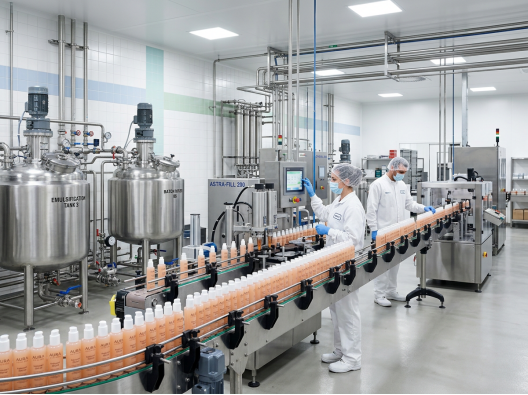
The cosmetics manufacturing industry is undergoing an unprecedented quality transformation. As consumers demand higher product safety and efficacy — and regulators worldwide tighten standards (China's Cosmetics Supervision and Administration Regulation; EU Cosmetics Regulation EC 1223/2009) — production equipment hygiene requirements now approach pharmaceutical-grade levels.
Cosmetics manufacturing encompasses several distinct process stages: raw-material weighing and dispensing; pre-emulsification and dispersion; vacuum homogenization; cooling and storage; and filling and packaging. Each stage involves different fluid characteristics and control requirements, necessitating targeted selection of appropriate sanitary valves and pumps.
During emulsification, high-viscosity creams and lotions (typically 1,000–50,000 mPa·s) require rotary lobe pumps or progressive-cavity pumps for transfer, paired with large-bore butterfly or ball valves for line switching. Self-draining valve geometry is essential to prevent inter-batch cross-contamination from product residue.
AVM participated in the 29th China Beauty Expo (CBE) in 2025, presenting fluid-control solutions tailored to cosmetics-industry requirements. The company's hygienic product range — including butterfly valves, ball valves, diaphragm valves, and rotary lobe pumps — is fabricated entirely from 316L stainless steel and meets FDA food-contact-material standards, making it fully suitable for cosmetics production environments.
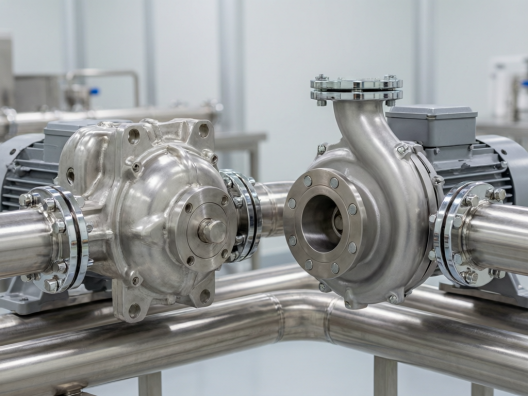
The filling stage demands the highest precision and cleanliness. Cosmetics filling valves must deliver: accurate dose-volume control (ensuring fill-weight consistency); rapid response (maintaining high line speeds); zero-drip performance (preventing product waste and equipment contamination); and fully cleanable construction (enabling rapid color/product changeovers).
Cosmetic formulations frequently contain fragrance oils, essential oils, and organic acids that exhibit some corrosivity toward metals — making material compatibility an important specification criterion. 316L stainless steel provides excellent resistance to most cosmetic ingredients, while FKM is typically the first-choice seal material for broad chemical tolerance.
AVM recommends a single-source supply model for cosmetics-facility projects: sourcing valves, pumps, fittings, and sight glasses from one manufacturer ensures interface-standard consistency, uniform quality levels, and simplified after-sales service. AVM's comprehensive product portfolio and ISO 9001 quality system provide cosmetics-industry customers with reliable, regulation-compliant equipment solutions.