
 EN
EN
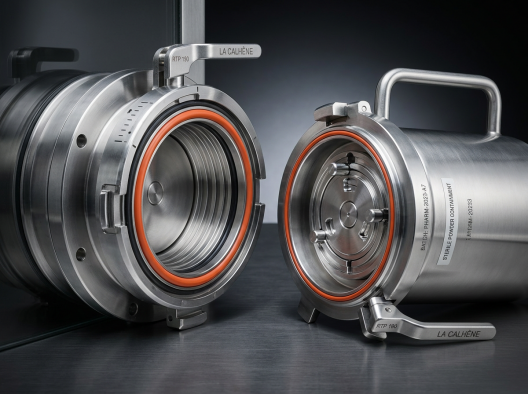
The Rapid Transfer Port (RTP) — also referred to as an alpha-beta valve — is the industry benchmark for achieving high-containment powder transfers in pharmaceutical manufacturing. When handling compounds classified at OEB4 (OEL 1–10 µg/m³) or OEB5 (OEL < 1 µg/m³), an RTP system provides the mechanical barrier necessary to protect operators and the surrounding environment from potent-drug exposure.
The RTP concept relies on two complementary halves: the alpha port (permanently installed on the process vessel or isolator wall) and the beta port (mounted on the mobile container such as a drum, keg, or liner). During docking, only the sealed faces of the two halves come into contact; twin O-ring seals and an interlocked mechanical sequence ensure that the powder pathway remains fully enclosed from connection through transfer to disconnection. Airborne particulate concentrations during operation routinely measure below 1 µg/m³ when validated per ISPE SMEPAC methodology.
AVM's RTP product line features a 316L stainless-steel body with POM304 components for non-wetted mechanical parts. All product-contact seals are manufactured from FDA 21 CFR 177.2660-compliant fluoroelastomer (FKM) or silicone rubber. Wetted surfaces are polished to Ra < 0.4 µm; non-wetted surfaces to Ra < 0.8 µm — meeting or exceeding ASME BPE surface-finish classifications for pharmaceutical service.
Core application scenarios include: isolator-to-isolator material movement; reactor charging of potent APIs; intermediate bulk container (IBC) filling and discharge; and contained sampling of high-hazard powders. Compared with conventional open-transfer under laminar airflow, an RTP system reduces operator exposure by two to three orders of magnitude — a critical factor for compliance with EU GMP Annex 1 and FDA guidance on potent-compound manufacturing.

Engineering selection criteria encompass: port diameter (4″ through 10″ nominal); required containment band (based on compound OEL classification); process connection standard (DIN, Tri-Clamp, or flanged); actuation mode (manual lever, pneumatic, or servo-electric); and integrated wash-in-place (WIP) capability for inter-batch decontamination.
AVM's RTP platform carries ISO 9001 quality-system certification and 3-A sanitary authorization. Every unit is manufactured on Mazak CNC equipment to tight dimensional tolerances, 100% pressure-tested, and shipped with a full qualification documentation package. For pharmaceutical customers, AVM also provides independent SMEPAC containment-verification data to support DQ and OQ activities.
The business case for RTP extends well beyond health and safety: reduced product loss during transfer, simplified cleaning validation, lower PPE costs, and robust audit readiness for regulatory inspections. Selecting a manufacturer with proven traceability systems and third-party containment verification is the critical first step toward a successful high-potency facility project.