
 EN
EN
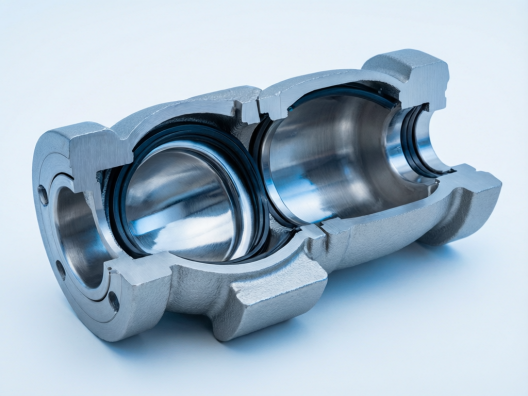
The inflatable-seal ball valve represents an advanced approach to achieving absolute zero-leakage shutoff in demanding biopharmaceutical applications. Unlike conventional ball valves that rely on spring-loaded or pressure-energized seats, this design employs a pneumatically inflated elastomer seal that expands against the ball surface only when the valve is in the closed position — delivering metal-to-metal equivalent sealing performance with dramatically extended seal life.
The mechanism operates on an elegant principle: when closure is commanded, compressed air or inert gas inflates a specially engineered annular seal, pressing it uniformly against the ball's polished surface to create a gas-tight barrier. When the valve opens, the seal deflates and retracts away from the ball, allowing friction-free rotation. This inflate-on-close, retract-on-open cycle yields three significant advantages: first, seal contact occurs only during closure, vastly reducing abrasive wear; second, bubble-tight shutoff is achieved regardless of line pressure; third, opening torque is minimal, reducing actuator sizing requirements.
AVM's inflatable-seal ball valve is purpose-designed for hygienic service, with a 316L stainless-steel body polished to Ra < 0.4 µm on all wetted surfaces. Products conform to 3-A Sanitary Standards and GMP design requirements, with seal materials available in EPDM, FKM, and silicone — all FDA 21 CFR 177.2660 compliant.
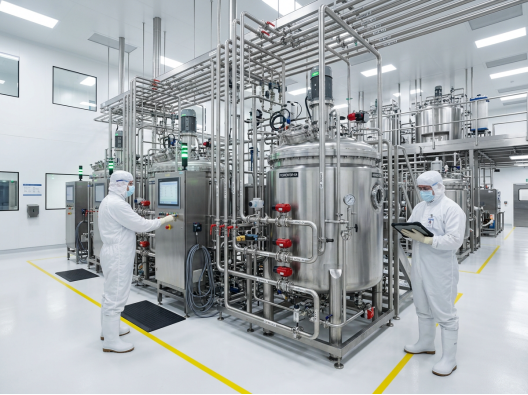
In biopharmaceutical manufacturing, typical installations include: bioreactor bottom-drain valves (requiring complete heel-free discharge); sterile media-prep system isolation valves; chromatography column inlet/outlet shutoff; and pure-steam isolation service. The crevice-free, fully-drainable geometry ensures thorough CIP/SIP penetration, satisfying validation requirements for aseptic processing.
Key specification parameters encompass: nominal diameter; pressure rating (typically PN10–PN40); seal material selection based on process chemistry and temperature; inflation pressure range; media temperature limits; and ATEX certification requirements for installations in potentially explosive zones. For SIP applications (typically 121 °C / 30 min), seal material high-temperature endurance is a critical evaluation factor.
AVM leverages its advanced CNC machining capabilities and ISO 9001 quality management system to ensure every inflatable-seal ball valve undergoes 100% hydrostatic testing and seal-performance verification before shipment. With over two decades of experience in sanitary fluid-control equipment manufacturing since 2003 and a global export footprint, AVM provides a proven, reliable solution for bioprocess engineers seeking the ultimate in shutoff performance.