
 EN
EN
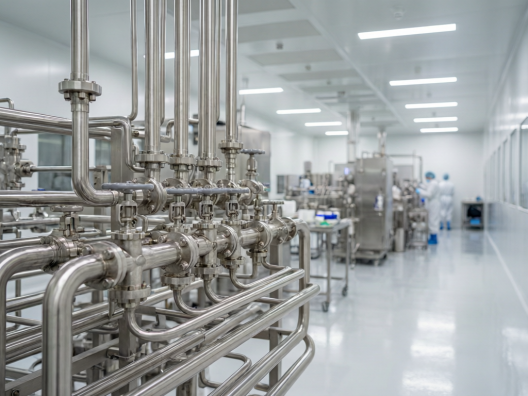
The sanitary diaphragm valve remains one of the most widely specified flow-control devices in biopharmaceutical and food processing. Its inherently hygienic design fully isolates the actuator mechanism from the process fluid, eliminates dead legs, and delivers a self-draining flow path — making it the default choice for sterile and ultra-clean applications.
Operating principle is elegantly simple: a flexible, FDA-compliant diaphragm is pressed against a weir-type or radial seat to shut off flow, then lifted to allow passage. Because the process fluid contacts only the valve body interior and the underside of the diaphragm, there are no packing glands, stem seals, or crevices where biofilm can develop — a decisive advantage for systems requiring validated CIP/SIP cycles.
Material selection is critical. Valve bodies are typically 316L stainless steel (EN 1.4404), prized for its resistance to chloride-containing sanitizers and caustic/acid CIP chemistries. Diaphragm materials include EPDM (service to 150 °C, broad chemical compatibility), PTFE/EPDM composite (excellent chemical resistance to 200 °C), and platinum-cured silicone (superior biocompatibility, preferred for WFI and cell-culture media service).
AVM manufactures its aseptic diaphragm valves in strict accordance with DIN, SMS, 3-A, IDF, and ISO standards while meeting the overarching requirements of FDA 21 CFR and EU GMP Annex 1. Internal bore finishes are held to Ra ≤ 0.4 µm using precision CNC machining on the company's Mazak multi-axis turning centers and Korean high-accuracy machining platforms.
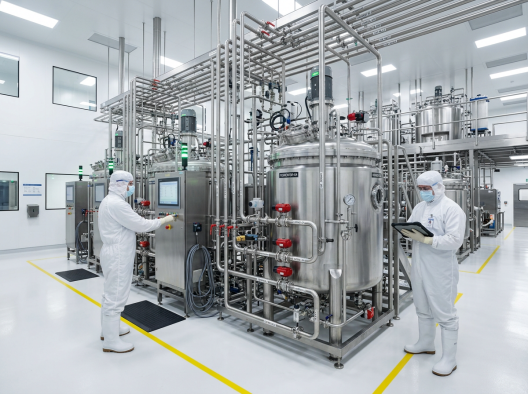
Key specification parameters include: pressure rating (typically 0–10 bar); temperature class (dictated by diaphragm material); end connections (Tri-Clamp, butt-weld, threaded union); actuation type (manual handwheel, pneumatic, or electric); and validated CIP/SIP compatibility. For critical aseptic applications, specifiers should also confirm that the valve geometry meets ASME BPE drainability criteria (3-degree minimum slope on horizontal installations).
In bioprocessing, diaphragm valves dominate chromatography skids, buffer-preparation systems, WFI distribution loops, and CIP/SIP manifolds. Their zero-dead-leg geometry and full drainability drastically reduce microbial hold-up risk, satisfying the stringent expectations of EU GMP Annex 1 (2022 revision) for sterile manufacturing.
An ISO 9001-certified manufacturer like AVM delivers not only the valve hardware but the complete documentation package — 3.1B material certificates, hydrostatic test reports, surface-finish inspection records, and weld logs — essential for successful IQ/OQ/PQ qualification in validated pharmaceutical facilities.