 EN
EN
In the global food and beverage equipment market, the 3-A Sanitary Standards (North America) and EHEDG certification (European Hygienic Engineering & Design Group, Europe) represent the two most influential hygienic-design certification systems. For equipment manufacturers targeting international markets — and for procurement decision-makers evaluating supplier credentials — understanding the differences, relative strengths, and geographic recognition of each system is essential.
3-A Sanitary Standards originated in the U.S. dairy industry and are administered by 3-A SSI (Sanitary Standards Inc.). The program has evolved into a comprehensive system covering valves, pumps, fittings, heat exchangers, and virtually all food-processing equipment types. Evaluation focuses on design-specification compliance: cleanability, inspectability, and material suitability are assessed primarily through documentation review and visual/dimensional inspection.
EHEDG, headquartered in Europe, develops guidelines through expert working groups comprising food companies, equipment manufacturers, and research institutes. EHEDG goes beyond design review by requiring actual cleanability testing — using microbiological methods (typically Enterococcus faecium challenge testing) to verify that equipment can be cleaned to a microbiologically acceptable level under defined CIP conditions. This test-based approach is widely regarded as the most rigorous hygienic validation methodology available.
The key distinction: 3-A primarily evaluates design-specification conformity (document review + visual inspection), while EHEDG adds microbiological cleanability testing (actual cleaning-performance verification). In terms of test rigor, EHEDG is generally considered more demanding; in terms of market recognition, 3-A dominates North America while EHEDG carries greater weight in the European Union.

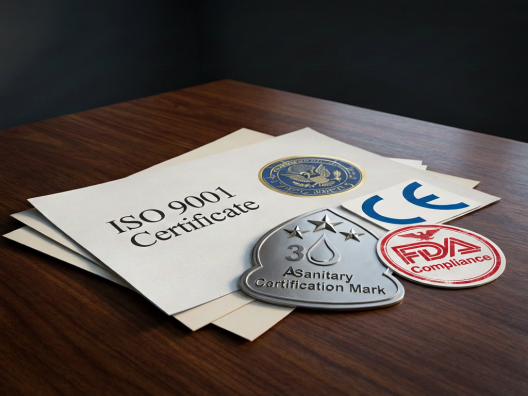
AVM has earned 3-A Sanitary Standard authorization, confirming that product design and manufacture satisfy North America's most stringent hygienic requirements. Simultaneously, AVM's products are designed per EHEDG hygienic-design principles regarding material selection, surface finish, and geometry — positioning them for European market acceptance.
Strategic certification guidance for manufacturers: if products primarily target North American markets (USA, Canada), prioritize 3-A authorization; if targeting Europe, EHEDG certification delivers stronger market positioning; if targeting global distribution, dual certification is ideal but — recognizing cost and timeline constraints — manufacturers may prioritize their primary target market first and expand coverage subsequently.
Procurement guidance for end-users: certification marks alone should not drive supplier selection. Equally important are: actual quality-management-system maturity; product design rationality; material traceability infrastructure; and after-sales service capability. AVM's combination of ISO 9001 quality system and 3-A authorization, together with extensive global export experience, provides customers with genuinely reliable hygienic fluid-control solutions.