
 EN
EN
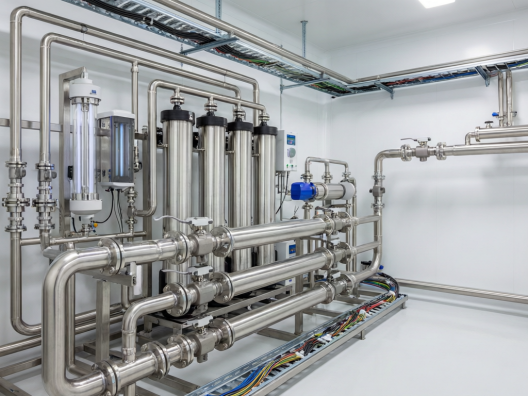
Water is the highest-volume raw material consumed in pharmaceutical, semiconductor, and food manufacturing. From municipal potable water to pharmaceutical-grade Water for Injection (WFI), and from electronics-grade ultrapure water (UPW) to food-process water — different applications span orders of magnitude in purity requirements. Within water generation, storage, and distribution systems, valve material and design directly govern achievable water quality.
Pharmaceutical water systems are classified in ascending purity: Potable Water → Purified Water (PW) → Highly Purified Water (HPW) → Water for Injection (WFI). WFI specifications demand: bacterial endotoxin < 0.25 EU/mL; total organic carbon (TOC) < 500 ppb; and conductivity < 1.3 µS/cm at 25 °C. Achieving and maintaining such purity requires that every system component — including valves — meets exacting hygienic standards.
The diaphragm valve is the dominant technology in pharmaceutical water systems. Its zero-dead-leg geometry eliminates stagnant-water zones where biofilm could develop; its fully-drainable design prevents water hold-up that supports microbial proliferation; and its excellent compatibility with 316L stainless-steel orbital-welded piping systems makes it the natural choice. AVM's sanitary diaphragm valves — finished to Ra < 0.4 µm — fully satisfy PW, HPW, and WFI system requirements.
Ultrapure-water distribution systems are designed around the principle of continuous circulation: water must remain in constant motion to prevent microbial colonization. All valves must therefore exhibit "zero-dead-leg" characteristics per ISPE Water and Steam Guide recommendations, and connections should preferably be orbital-welded or Tri-Clamp to eliminate the crevice risk inherent in threaded joints.
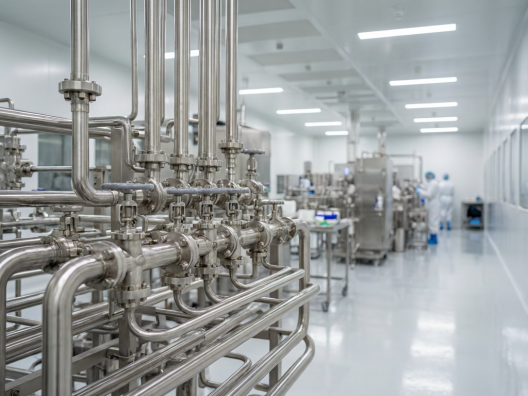
In pre-treatment stages (e.g., RO feed-water control), standard stainless-steel ball or butterfly valves may suffice. However, downstream of RO membranes and throughout the distribution loop, only 3-A or ASME BPE-qualified diaphragm valves should be specified — because even minor material leaching or surface defects could compromise water quality at ppb-level sensitivity.
For ongoing microbial control, hot-water sanitization (typically 80–85 °C circulating for 30–60 minutes) is standard practice. This requires all system valves to endure frequent thermal cycling without seal degradation. AVM's diaphragm valves offer EPDM or PTFE diaphragm options: EPDM for hot-water sanitization duty (rated to 150 °C); PTFE for chemically aggressive applications.
As an ISO 9001-certified specialist hygienic-equipment manufacturer, AVM's products are deployed in pharmaceutical, food, and electronics water-treatment systems globally. The company provides application-specific valve-selection recommendations and complete technical documentation packages to support system qualification and regulatory compliance.