
 EN
EN
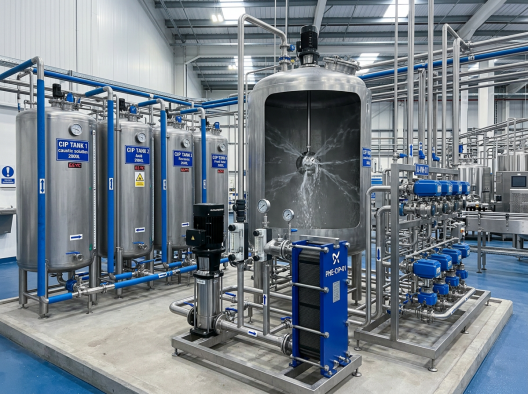
Clean-In-Place (CIP) is the foundational hygiene infrastructure in food, beverage, and pharmaceutical manufacturing — enabling automated, validated cleaning of process equipment without disassembly. A well-designed CIP system reduces downtime between production batches, ensures microbiological control, and provides documented evidence of cleaning effectiveness for regulatory compliance.
A complete CIP system comprises several key sub-systems: chemical supply tanks (caustic, acid, rinse water); CIP supply and return pumps; heat exchangers for temperature control; vessel spray devices (static spray balls or rotary jet heads); process-line valve matrices for flow routing; instrumentation (flow, temperature, conductivity sensors); and an automation/SCADA platform orchestrating the cleaning sequences.
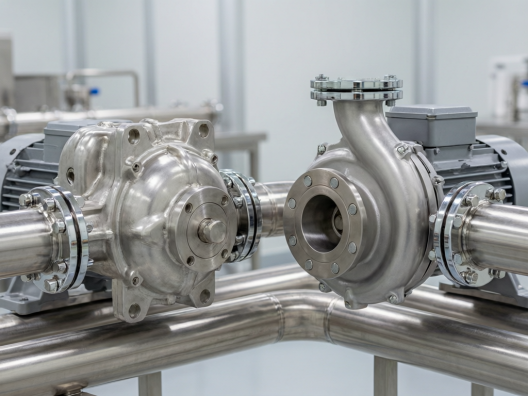
AVM supplies multiple critical components for CIP installations, including sanitary spray balls for tank interior coverage, CIP-duty centrifugal pumps optimized for high-flow/high-head cleaning circuits, and the full range of hygienic valves and fittings required for CIP distribution manifolds. All components are fabricated from 316L stainless steel and carry 3-A authorization and FDA material compliance.
Spray-device selection is a pivotal CIP design decision. Static spray balls — with no moving parts and excellent reliability — suit vessels under approximately 5,000 L where moderate cleaning intensity suffices. Rotary spray heads generate high-impact jets through mechanical or hydraulic rotation, delivering superior wall-coverage and cleaning power for large tanks, heavily soiled surfaces, or difficult-to-clean geometries.
Valve configuration for CIP systems typically requires: butterfly valves (line switching and flow routing); diaphragm valves (precise flow modulation and zero-dead-leg isolation); mixproof valves (safe separation between product and CIP circuits); sample valves (post-rinse water testing); and relief valves (over-pressure protection). Proper valve selection ensures that CIP chemistry reaches all surfaces at the required velocity, temperature, and concentration.
CIP pump specification must account for: total system pressure drop (piping friction + spray-device back-pressure); required volumetric flow (driven by pipe diameter and minimum CIP velocity — typically 1.5–3.0 m/s for pipeline circuits); fluid temperature (caustic wash typically 70–85 °C); and corrosion resistance to cleaning chemicals.
Successful CIP design demands that cleanability is designed into the entire process system: all piping must be self-draining; dead legs must not exceed 1.5–3× pipe diameter; and valve selection should prioritize self-draining, crevice-free geometries. AVM's comprehensive product portfolio and ISO 9001 quality system provide customers with a single-source solution from individual components through to integrated system packages.