
 EN
EN
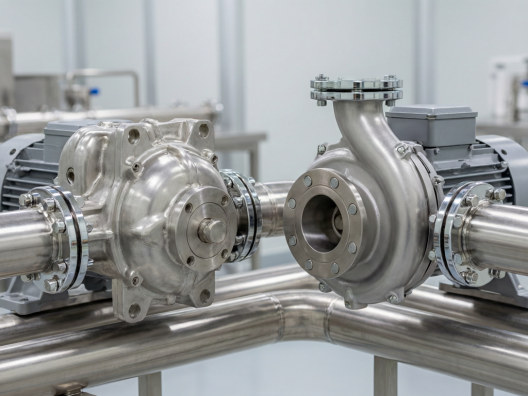
Selecting the correct pump technology is one of the most consequential engineering decisions in any food-processing facility. The two dominant hygienic pump families — rotary lobe (positive-displacement) and centrifugal — each offer distinct performance characteristics suited to different process conditions. Understanding their respective strengths and limitations is essential for optimizing production efficiency, preserving product quality, and minimizing total cost of ownership.
The sanitary rotary lobe pump operates on a positive-displacement principle: two counter-rotating lobes trap fluid between themselves and the pump casing, propelling it from suction to discharge. Key advantages include: capability to handle extremely high-viscosity products (sauces, honey, chocolate — up to 1,000,000 cP); excellent self-priming characteristics; linear flow-rate vs. speed relationship enabling precise dosing; and gentle, low-shear handling of particulate-laden or shear-sensitive products (fruit yogurt, whole-berry jams) without damage to suspended solids.
The sanitary centrifugal pump, by contrast, generates flow through the kinetic energy imparted by a high-speed impeller. Its strengths lie in: high flow capacity (hundreds of m³/h); simple construction with fewer wearing parts; lower capital cost per unit flow; and ideal suitability for low-viscosity fluids (water, juice, milk, thin syrups). In CIP return circuits, centrifugal pumps are the universal standard.
AVM offers both pump technologies in its hygienic product portfolio. The company's rotary lobe pumps serve viscous-product applications across the food, dairy, and personal-care industries, while its CIP centrifugal pumps are engineered specifically for cleaning-system duty. Both product lines are fabricated from 316L stainless steel and carry 3-A authorization and FDA material compliance.
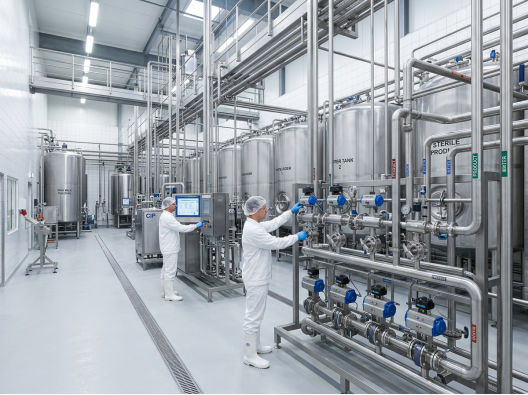
A practical selection matrix: when product viscosity exceeds 500 cP, specify a lobe pump; when viscosity is below 50 cP and flow demand is high, a centrifugal pump is more efficient; when volumetric accuracy is required (batching, dosing), the lobe pump's positive-displacement characteristic is superior; when system pressures exceed 10 bar, evaluate lobe-pump seal reliability carefully; when product contains large solids or fibers, select a pump geometry designed for particle passage.
In a typical juice plant, centrifugal pumps transfer raw juice, lobe pumps fill concentrated fruit preparations, and CIP pumps circulate cleaning chemicals — demonstrating how both technologies complement each other within a single production facility.
AVM's ISO 9001 quality system and Mazak CNC manufacturing equipment ensure that pump components meet the exacting dimensional and surface-finish requirements of sanitary standards. Products are deployed globally across food, beverage, dairy, and pharmaceutical industries. Engaging a specialist hygienic-pump manufacturer for application-specific sizing and selection is the critical first step toward project success.