
 EN
EN
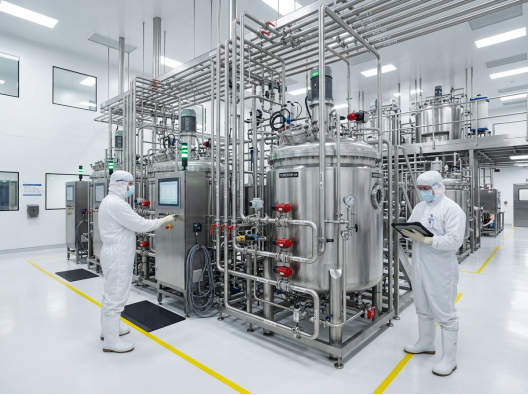
Biopharmaceutical manufacturing — encompassing monoclonal antibodies, vaccines, cell therapies, and gene therapies — imposes the most demanding requirements on fluid-control equipment of any industrial sector. Unlike traditional small-molecule drug production, bioprocessing's central challenge is maintaining absolute sterility throughout the entire manufacturing chain, because biological products are exquisitely sensitive to microbial contamination.
In upstream cell-culture operations, the bioreactor (fermentor) is the process centerpiece. Associated critical valves include: bottom harvest valves (requiring complete heel-free discharge — typically inflatable-seal ball valves or diaphragm valves); feed-addition valves (precise control of media and nutrient feeds); aseptic sampling valves (enabling sterile sample withdrawal without compromising vessel integrity); and exhaust valves (managing headspace pressure and off-gas).
Downstream purification — spanning ultrafiltration, chromatography, viral inactivation, and sterile filtration — places additional demands on valve material compatibility. Chromatography buffers often contain high salt concentrations or organic solvents, requiring broad chemical resistance from seal materials. AVM's diaphragm valve platform offers multiple elastomer options (EPDM, PTFE-faced, FKM) to match diverse downstream chemistries.
AVM's product portfolio comprehensively covers biopharmaceutical process requirements. Sanitary diaphragm valves, butterfly valves, ball valves, and sampling valves are manufactured from 316L stainless steel with wetted surfaces polished to Ra < 0.4 µm, conforming to ASME BPE standards and FDA requirements for bioprocessing equipment.
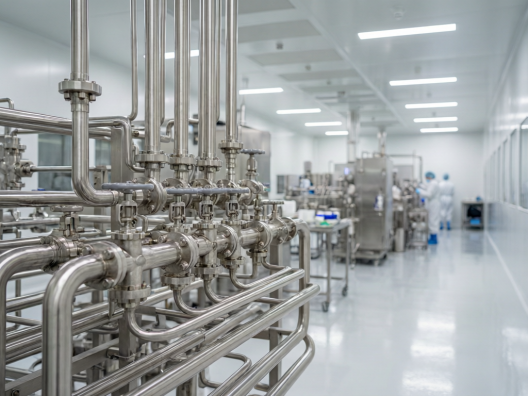
Sterilizability is a key selection dimension in aseptic systems. Steam-In-Place (SIP) operations require valves to endure repeated exposure to 121–134 °C saturated steam without seal degradation. Additionally, valve installation geometry must ensure complete condensate drainage to eliminate "cold spots" where inadequate sterilization temperatures could harbor viable microorganisms.
AVM recommends a systems-level specification approach: begin by defining the User Requirement Specification (URS), then select valve types and sizes based on individual fluid characteristics (temperature, pressure, chemical nature, particulate requirements) and duty cycle (CIP/SIP frequency, actuation cycles). This methodology ensures sterile assurance while optimizing valve count and spare-part commonality.
With ISO 9001 certification and over two decades of sanitary-equipment manufacturing expertise, AVM serves biopharmaceutical customers globally — from equipment selection through technical documentation support for commissioning and qualification activities.