 EN
EN
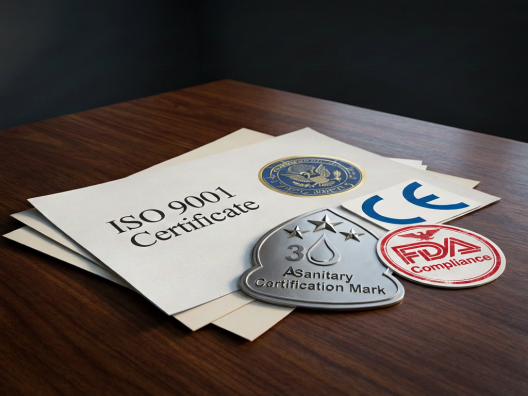
The 3-A Sanitary Standards program is North America's premier equipment-hygiene certification system for the food, beverage, and dairy industries. Jointly governed by the International Association for Food Protection, the Food Processing Suppliers Association, and regulatory authorities including the USDA and FDA, 3-A authorization on equipment signifies that its design and manufacture meet the most stringent hygienic requirements for food-contact service.
Three core principles underpin the 3-A framework: Cleanability — all product-contact surfaces must be effectively cleanable using standard CIP procedures; Inspectability — equipment must be designed to allow visual inspection of cleaned surfaces; and Material Suitability — all food-contact materials must be non-toxic, non-absorbent, and corrosion-resistant under normal service conditions.
For sanitary valves and fittings (governed primarily by 3-A Standard 62-xx), specific requirements mandate: metallic components fabricated from AISI 300-series stainless steel; product-contact surface roughness ≤ 32 micro-inch (approximately Ra 0.8 µm); elastomeric seals compliant with FDA 21 CFR 177.2600; self-draining geometry with no fluid-trapping dead legs; and mechanical design permitting complete disassembly for inspection.
AVM has earned 3-A Sanitary Standard authorization, with its hygienic valve and fitting products fully satisfying all applicable technical requirements. Notably, AVM's surface-finish standard exceeds the 3-A minimum — product-contact surfaces are finished to Ra < 0.4 µm (approximately 16 micro-inch), providing an enhanced hygiene safety margin beyond regulatory minimums.

The 3-A certification process involves: application submission to 3-A SSI (Sanitary Standards Inc.); product design review against the applicable standard; manufacturing-process conformity assessment; independent on-site audit and product inspection by an accredited Third Party Certification Inspectors (TPCI); and authorization to use the 3-A Symbol. Certification is typically valid for three years, with periodic surveillance audits.
For Chinese manufacturers exporting to North American markets, 3-A authorization serves both as market-access credential and as powerful evidence of product quality and food-safety commitment. While 3-A dominates in North America, EHEDG certification carries greater weight in European markets — manufacturers targeting global distribution benefit from pursuing both credentials.
AVM's dual certification (ISO 9001 quality system plus 3-A Sanitary authorization) provides global customers with comprehensive quality assurance. Whether in dairy processing, juice production, or brewery operations, AVM products meet the highest food-safety standards demanded by the world's most regulated markets.